
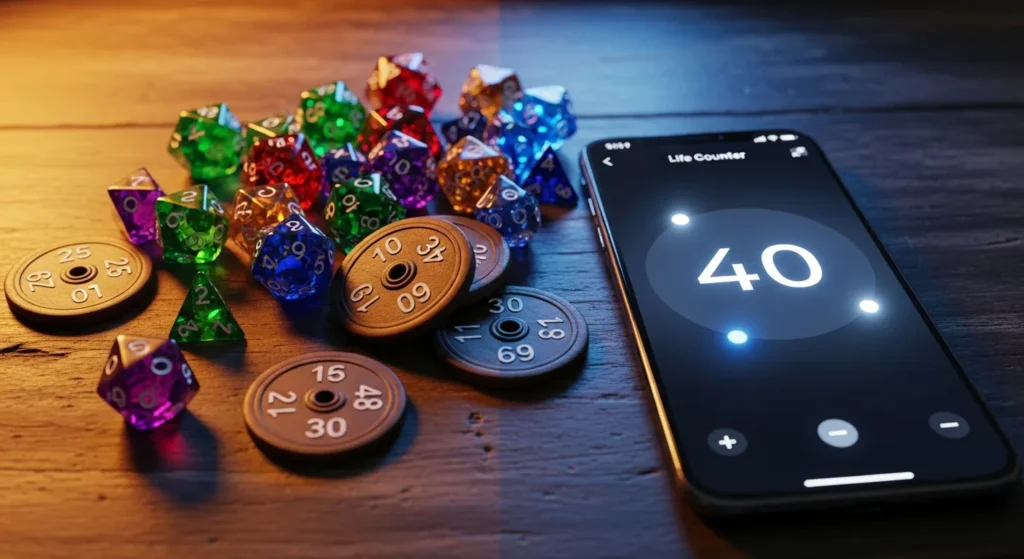
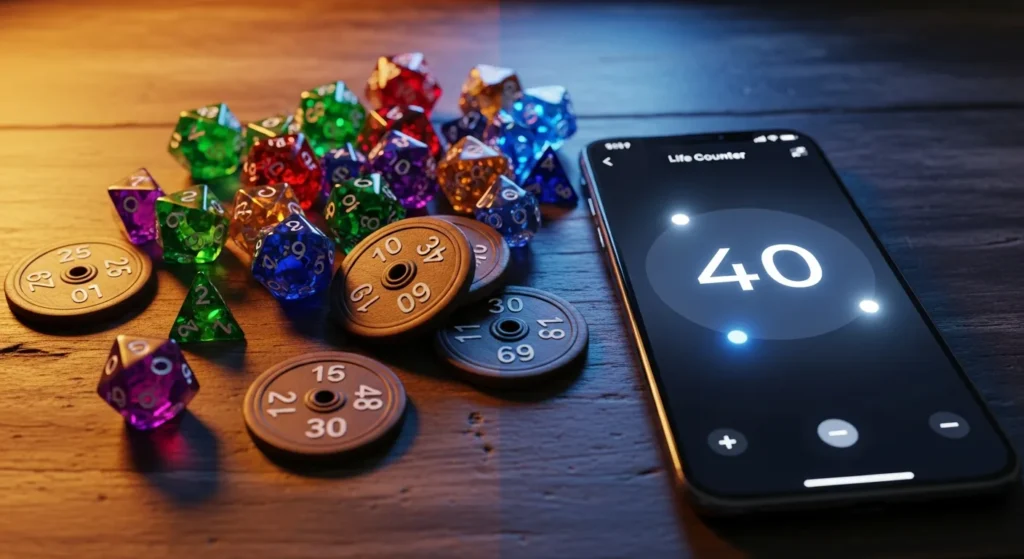
Comparing the Pros and Cons of the Two Categories of MTG Life Counters
- A life counter app helps you accurately track of life totals during a game of Magic.
- Physical counters (dice, wheel, abacus) are tangible and fun, but one-dimensional and accident prone.
- Digital counters are much more flexible, keep track of more than just life, and (if an app) always with you on your phone.
- Both offer personalization and customization.
- Digital solutions like MatchPunk are essential, as they can track wins and losses, plus they help you run events and tournaments.
Intro: “Should I get a physical or digital life counter?”
Everyone knows you need a deck to play Magic: The Gathering.
And everyone knows you need a commander and 100 non-duplicate cards to play Commander.
But less known is this: every player needs an mtg life counter.
In general, there are two types: physical and digital.
This guide will compare physical life counters with their digital counterparts…
exploring the pros and cons of each…
To help you decide which is best for you.
Quick Life Counter FAQ
“What is an MTG life counter?”
A Magic: The Gathering life counter is any device a player uses to track the damage done by the opponent. It’s the “score keeper” of the game.
“Why is it needed?”
Because Commander and MTG are A) strategic games that require critical thinking and B) the life totals (or Commander damage, commander tax, poison damage, etc.) are constantly changing based on which cards are played. It’s tough to focus on the game and remember the score at the same time.
“What are some examples?”
Dice, dials, wheels, spinners, apps… even eraser boards! We listed every category of Magic: The Gathering life counters in this post.
“What are the benefits of a good life counter?”
- Less game management
- Focus on tactics and fun
- Smoother gameplay
- Accurate scorekeeping
- Removes table disputes
- A clear and visible record
- Fun game trinkets
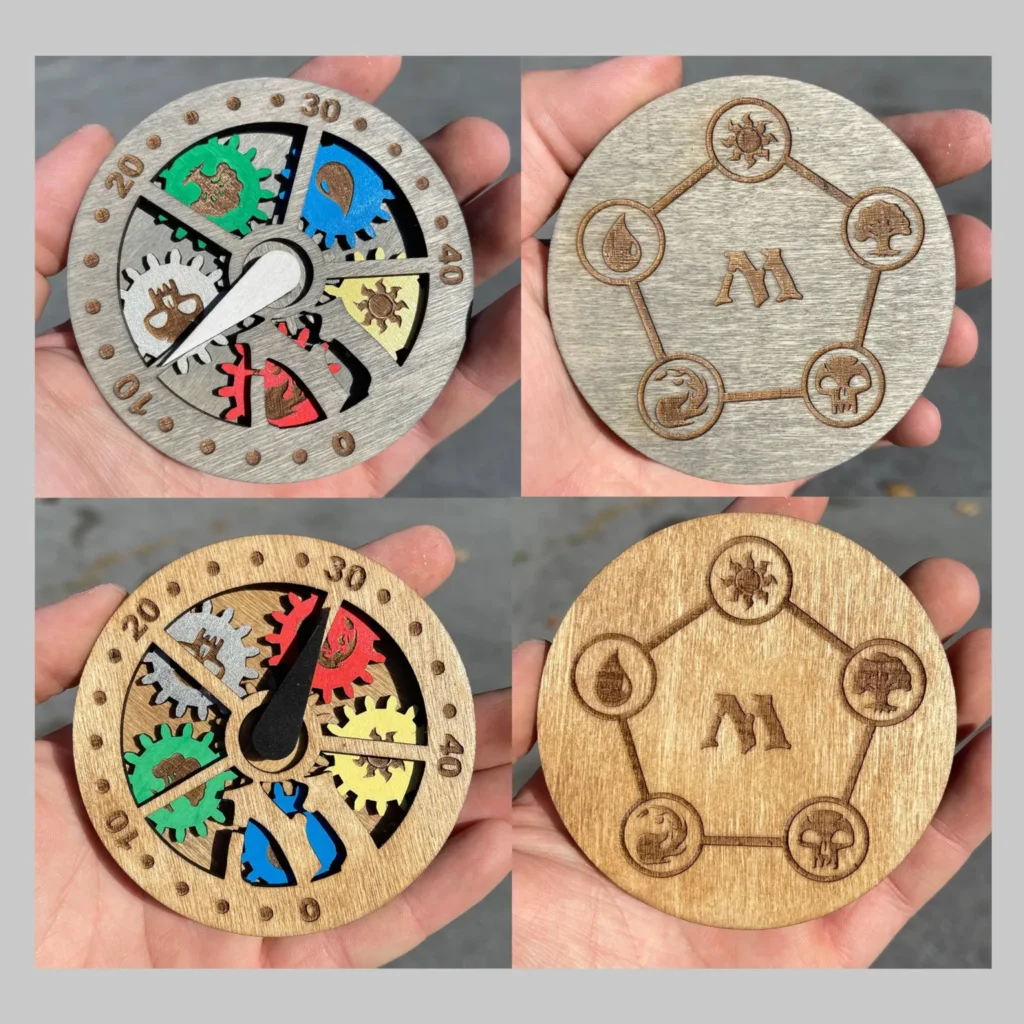
Image not property of MatchPunk (source)
Physical Life Counters Explained
If something is a tangible object you use to track life, then it falls under the category of “physical life counters”. And despite the rise of mtg digital life counter options, physical life counters still have a special place in the hearts of many players:
- The most common physical life counter is the 20-sided die, or d20.
- Spindown dice, which have consecutive numbers arranged in a sequence (Life change? Just follow the arrow of the die to change your score).
- Another popular option is the wheel counter. These devices feature one or more rotating wheels that display numbers.
But we’re not here to just list off specifics. The appeal of this or that physical life tracker is obvious once you actually see the thing. For a full list of all different physical life counters, read this post on the complete Magic: The Gathering Life Counter List.
Instead, this section articulates the four benefits shared by nearly all physical life counters.
Benefit 1: No Battery Required
They are just there, doing the only thing they were designed to do: track mtg life. No batteries to change. No software to update. No searching for an internet connection. If you have it, you can use it.
Benefit 2: Tactile Material (stone, plastic, wood, and metal)
Of course, mtg digital life counters still are used with physical objects (phone, computer, etc.). But what sets them apart from digital life counters is that they are … ya know… REAL. Physical. Durable. Material. Present. Rigid. Heavy.
And without getting too deep into “realism” school of philosophy… there is something inherently SATISFYING about a physical life counter. Maybe it is the weight of the stone dice. Maybe it is the “click” the metal dial makes as you turn the wheel. Regardless, lots of people enjoy, appreciate, and just prefer tactile engagement instead of tapping a touchscreen.
Magic is best played in person with physical cards. And having a physical life counter can help players feel more connected to the game’s physical nature.
Benefit 3: Aesthetics!
Similar to the point above, most physical mtg life trackers are well designed. Which means they are more than practical tools. In their own small, unique way… they are beautiful. And humans like beautiful things.
How? Maybe its the sound of smooth wood beads sliding on a rod. Maybe it’s how tokens represent the reality of their life better than a number. Or maybe it is paint or plastic color that matches the Commander card.
When most physical life counters are functionally the same, the aesthetics set them apart. A life counter becomes a form of self-expression, an elevated piece to the match, or just a pretty trinket you like.
Benefit 4: No Distractions
One final benefit… the main downside of a phone-based life tracker is that your phone comes with other stuff. Like, A LOT of other stuff.
During a single game of Commander might, your phone might “ping” with notifications from email, instagram, tik tok, ESPN, Discord, Youtube. And every alert is another time you are being distracted from the game.
Not to mention, the people around you! Magic is a social game. It’s best in person. And sometimes… and remember this is coming from a digital MTG life counter business… it’s best to unplug and be fully present in the real world. You’ll not only appreciate your fellow players more, but probably play better too!
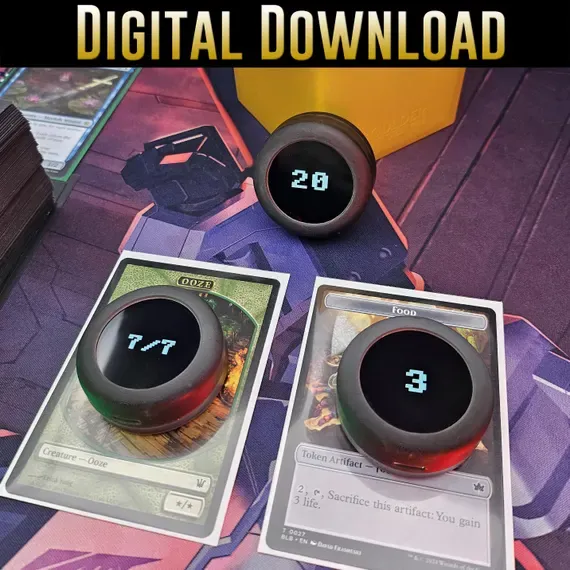
Image not property of MatchPunk (source)
Digital and Electronic Life Counters for MTG
Digital age = digital life counters.
This includes advanced smart tablets with a stylus to a dial you turn to change the score.
But most common form is an mtg life counter app, available on any smartphone.
For more information on mtg digital life counter apps, please refer to this post highlighting better options to the Companion App. Like above, this section will discuss what they all have in common.
10 Features That Set Digital Life Counter Apps Apart
Benefit 1: More Secure Score
Every physical counter is great until someone bumps into your table. Or a dog reaches for some nachos and knocks everything down. This chaos is normal at home and at the FLGS. But the disruption leaves everyone guessing what the correct life total was. With digital life counters, the only way the score accidentally changes is if someone taps the wrong side of the screen (MatchPunk doesn’t have this problem… more on that soon!)
Benefit 2: Always Available
99% of people carry their smartphones everywhere they go. Which means, with a digital life counter app, they carry their life tracker everywhere they go. You can just have a deck in your car, bag, or pocket and play whenever. And honestly? This is probably digital’s biggest advantage over physical. Its just so freaking convenient.
Benefit 3: Multiplayer
Nearly every single physical life counter only tracks for a single player. But MTG is a multiplayer game. Commander sometimes has 5 players, and an mtg digital life counter, even a simple one, can keep EVERYONE’S score. You simply tap designated areas on the screen to add or subtract life. Instead of needing 4 or 5 life counters in order to play, you can just pull out a phone, set it in the center, and track multiple stats for several players on one screen.
Benefit 4: Flexible
Most life tracker are for PvP OR Commander. Most life tracker apps switch from PvP to Commander with a single tap. If you’re going to an event dedicated to only one format, this isn’t a big deal. But if you’re getting together with friends and you won’t know what you’ll be playing until you get there, it might be kinda annoying to have to bring two physical devices. And DEFINITELY annoying to bring the wrong one.
Benefit 5: Visible
The digital life counter sitting in the middle of the table allows players to see the life count of all other players, as well as some other stats, like Commander Damage. This is not easy … and sometimes impossible… if each player has a physical life counter in front of them.
Benefit 6: Customization
Yes, you can choose a physical tracker to match your deck. But it’s much more permanent and unable to adapt to your personal style. Many digital trackers allow you to change the colors, font, avatars, background, and layouts. Load custom backgrounds to match any and every deck you own.
Benefit 7: Tracking Many Stats
When using a physical device, you need a new “thing” for every new stat tracked. But a life counter app instantly and effortlessly can track life, commander damage, +1/-1 counters, energy, monarch, poison damage… FOR EVERY SINGLE PLAYER. This solves the organizational nightmare that tracking a four-player game on paper can become. Some even help with zone tracking!
Benefit 8: Win/Loss Record
Unless you keep a detailed notebook or spreadsheet of all your victories, your record is more a guesstimate than anything else. But an advanced life tracker (like MatchPunk) will have a record of every game you ever played with the app. Your entire game history at your fingertips. Learn not only how often you win or lose, but when and against whom and with what deck!
Benefit 9: Events and Tournaments
Playing is always fun. But events are when you don’t just play for fun… who wins and loses matters. And very few event organizers are going to rely on your physical dial. Long story short: you may not be able to participate in an MTG tournament with only a physical device. You’ll need an mtg digital life counter. And unless the event coordinator just loooooves manually entering every win and loss on a white board, you will need to be on the same platform everyone else is using, which will likely be the Companion App or Match Punk (more on that in a second!)
Benefit 10: All-in-One Tools
While some physical counters are all-in-one tools. They come with a card database, links to online stores, even a VTT. You could play PvP or Commander on a desktop or your phone with a friend on the other side of the globe. No counter, table, or even a deck is needed! Of course, these versions ain’t cheap. At a minimum you’ll be paying upwards of $5 a month.
“What are the main problems with mtg digital life counters?”
Bad digital life trackers will have issues with battery life and privacy. It doesn’t matter how helpful they are if they drain your battery in hours. And who cares how good it is at score keeping if it is tracking you throughout the day.

Image not property of MatchPunk (source)
Choosing The Best MTG Life Counter for YOU
Choosing your first life counter doesn’t have to be complicated. If you’re just starting, you don’t need the most expensive or feature-rich option. A simple method to track of life totals is all you need to get going. Many beginners start with a free version of a life tracker app.
- Go to an PvP or Commander event at a FLGS.
- See what they have for sale there, and try it out yourself.
- If you REALLY like the physical counter, shop online or at a convention for the one just for you.
- If you are undecided, ask players you trust what they prefer.
- Before committing to a paid platform, find a free digital app and give it a try.
- If you like playing with an mtg digital life counter, survey the best ones for Magic, Commander, or both.
- Begin some free trials to find the one you like the most.
This approach lets you get a feel for what features you find useful without any financial commitment. As you play more, you’ll discover your personal preferences, which will guide you toward the perfect long-term solution for tracking your life total.
“Where can I find MTG life counter devices?”
- Amazon: fastest, cheapest delivery.
- Etsy: hand designed by fans and players.
- Local Game Stores: Your FLGS will have life counters and other essential MTG gear.
- Online Stores: Sites like MTG Pro Shop and Ultimate Guard
- App stores: Google play store for Android and Apple App store will have tons of mtg life counter apps.
“Can I 3D print my own life counter?”
We don’t see why not! If you have access to a 3D printer, you can find countless models online to 3D print your own life counter. Websites like Thingiverse and MyMiniFactory host a variety of designs, from simple dials to complex, multi-part counters.
“Are there smartphone apps for MTG digital life counters?”
Honestly… there are too many! There are TONS of life counter apps available for both iPhone and Android. Some are crazy simple: black and white with a single “button” for each player. Others are all-inclusive mega-tools seeking to be a life counter, stat tracker, deck builder, card reader, and event manager tool. Some are free. Most are VERY cheap.
“Which is better for Commander games?”
Definitely digital. And only because there are more things you are tracking. 40-point life total, commander damage and tax, and managing various resources… you can’t fit all that on a dial or dice. A physical counter can not only handle this level of information, but a digital mtg life counter can present your OPPONENTS life, damage (etc.) as well. All the information of the game at your right hand.
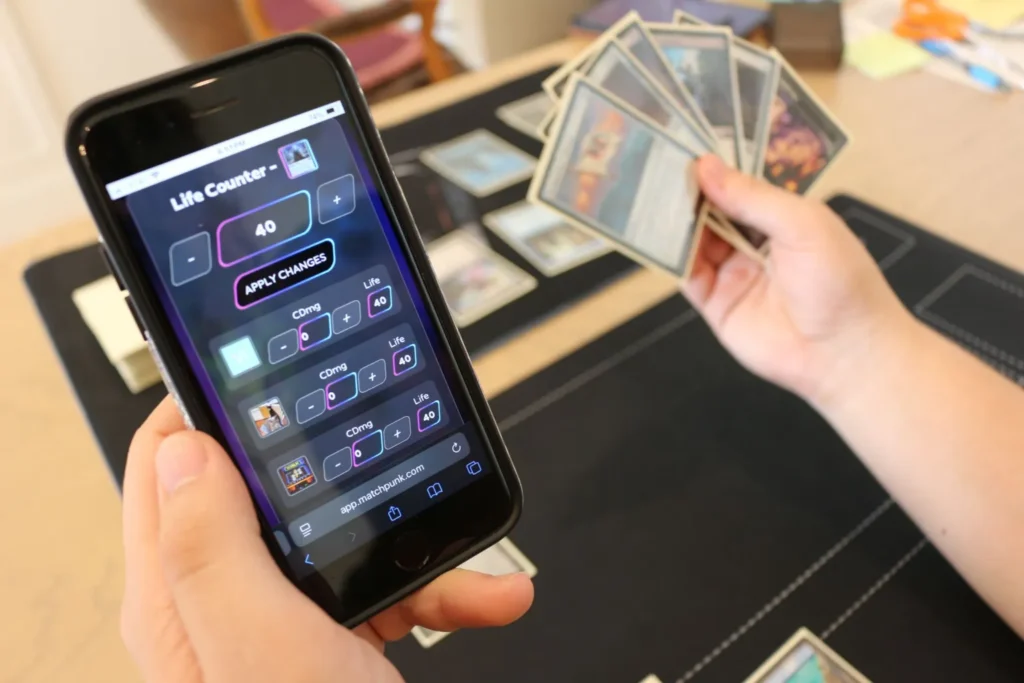
MatchPunk Our New and Improved Option
You’ve made it this far.
And I think we have made an honest and accurate assessment of the pros and cons of physical and digital life counters.
But now, we’d like to quickly make our case…
And pitch you to choose MatchPunk.
Making it your preferred mtg life counter app.
Because the truth is, we really, really, REALLY believe in this app.
Which is why we have no shame advocating for ourselves…
And have made it free for at least 2026 so that as many players can give it a try.
So, without taking too much time…
Here is what makes Match Punk different from all the other options out there:
- No Middle Phones: each player logs in on the site. Every stat is tracked simultaneously. But rather than a having the phone in the middle of the table, each player can glance down, next to their deck, and see all the relevant data for ALL players..
- Secure Score: Physical counters can be knocked or tipped over, or brushed aside. Digital life counters in the center of the table can be unintentionally altered by a finger brushing the wrong part of the screen. In both instances, the totall score is changed, with no indication of what the correct score was. Alternatively, MatchPunk will not register the new score unless a confirmation button is pressed, making it very difficult to accidentally alter the score.
- In-App Chat: Contact other members of the group to coordinate times to play, wish them luck, or talk trash.
- Custom Groups: Create as many groups as you want. Let whoever you want in. Make some hyper competitive. Others just for laughs. Join groups of different local game store.
- Weighted Player Ratings: Wins and losses are not only tracked, but RANKED. The more wins an opponent has, the better your rating increases for beating them. Watch your place rise and fall based on accurate performance.
- Effortless Events: Running Friday Night Magic has never been easier. Whoever wants to compete simply joins the group. The FLGS owner creates an event with a start and end time (can last hours or MONTHS). Once the event ends, the algorithm ranks compares wins/losses with player rankings throughout the event and immediately determines a winner.
In summary, we believe that the right life tracker can elevate your game of magic, making it more organized, competitive, engaging, and fun. Our goal was to create a tool that serves the needs of every player, from casuals to competitive grinders.
Conclusion: Physical vs Digital Life Counters…
Physical mtg life trackers are often beautiful accessories… but superfluous additions to the overall magic or commander experience.
MTG digital life counters are different. Like a lot of tech, they excel in being efficient, flexible, and convenient.
Both have ways for player personalization and pairing your life counter with your deck.
But the huge differentiator is running Commander events and MTG tournaments. While physical tools are no help at all, the digital life trackers can transform the experience for players and even organizers alike.
Our opinion? You NEED a digital life tracker… both for events and just cuz you always have your phone in your pocket… but that doesn’t mean you shouldn’t buy a beautiful physical device that catches your eye.
About the Author: This post was written by tabletop games marketing and writing agency Riley James Copy.
If you want to create and sell your own magic or tabletop game product, then click the link and learn about how his board game marketing strategy, branding, copy, and content can help you succeed.
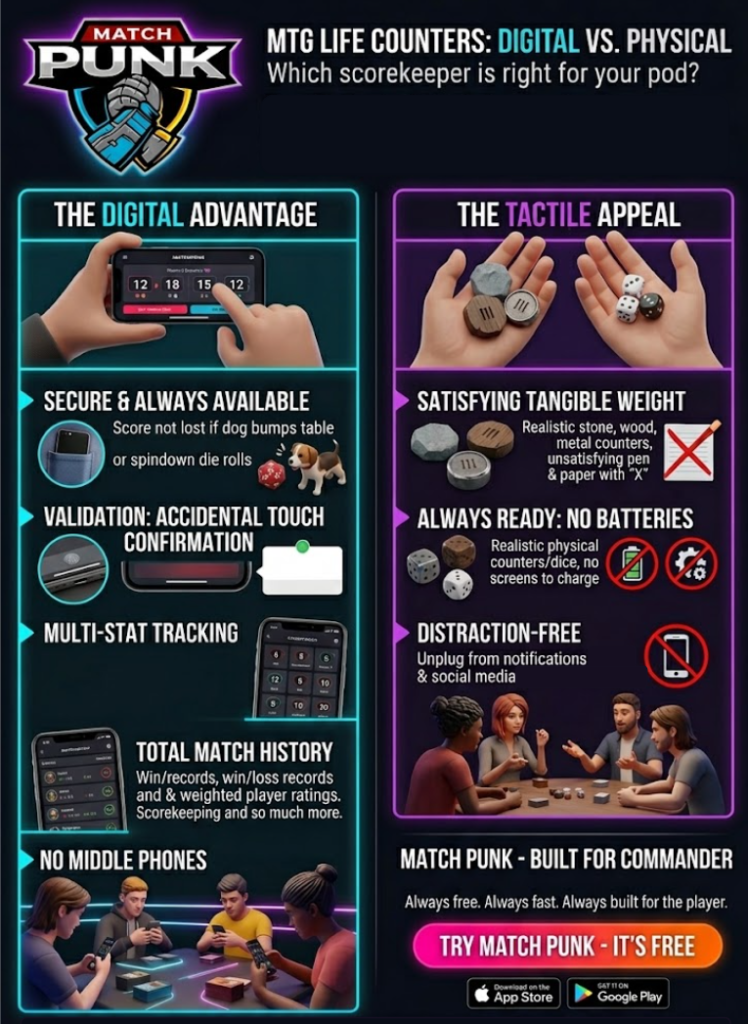
Learn more about MTG Digital Life Counter vs Physical | Best Apps Compared
Going Deeper: A Side-by-Side Breakdown
The sections above cover what physical and digital life counters do well on their own. Below, we stack them next to each other, format by format and player by player, then answer the questions players actually ask before they pick a side.
At-a-Glance: Physical vs Digital Life Counter Comparison
When you boil it down, the choice between physical and digital comes down to nine variables that matter to actual players. Here’s how they stack up:
| Feature | Physical Life Counter | Digital Life Counter |
|---|---|---|
| Cost | $0–$15 (spindowns often included free with Bundles and precons) | Free to $5+/month, depending on the app |
| Battery / power | None required | Drains phone battery |
| Players tracked | Usually 1 per device | 4–10 players in one app |
| Commander damage | Difficult; needs separate dice per source | Built-in, tracked per source |
| Counters (poison, energy, +1/+1) | Manual, easy to forget | Tracked automatically |
| Game history & win-loss record | None (unless you keep a notebook) | Saved automatically |
| Accidental score changes | Bumped dice = score gone | Confirmation-protected in Match Punk |
| Distraction risk | None | Notifications, screen-sleep issues |
| Tournament acceptance | Universal | Allowed at all REL, but paper still preferred at Competitive REL |
| Best for | Casual 1v1, kitchen-table Standard | Commander, multiplayer, leagues, organized events |
The pattern is clear: physical wins on simplicity and presence; digital wins on capacity and flexibility. Which matters more depends on what you’re playing, and how.
Physical vs Digital by Format
Magic: The Gathering isn’t one game. It’s a dozen. The right life counter changes with the format you’re queuing up.
Standard (20 life, 1v1): A spindown die does the job. The format is fast, life totals are low, and counters rarely come into play. Anything works. Pick what feels good in your hand.
Commander / EDH (40 life, 3–4 players, commander damage): Digital, with very few exceptions. You’re tracking 40 life for four players, commander damage from up to four sources for each of them, plus poison, energy, and whatever else hits the table. We’ve watched players try to manage this on dice. It falls apart by turn six.
cEDH: Digital for life and commander damage, paper as a backup for high-stakes calls. cEDH pods are competitive enough that a disputed life total can decide the game. Having an audit trail matters.
Modern, Pioneer, Legacy, and Vintage (20 life, 1v1): Either works, but fast micro-changes from fetch lands, shock lands, and Phyrexian mana add up. Spindowns are workable; dials are a pain. Paper or an app is cleaner.
Two-Headed Giant (30 shared life): Digital. Shared totals plus team coordination on triggers and counters need a screen everyone can see.
Friday Night Magic (FNM): Whatever the LGS supports. Some stores prefer app-tracked life because it syncs with event software like Companion or Match Punk, saving the organizer manual entry.
Competitive REL events (RCQs, Regionals, Pro Tour Qualifiers): Pen and paper, or an LCD writing tablet. Apps are allowed for tracking, but the written record is what judges trust during a dispute. More on why in the next section.
Physical vs Digital by Player Type
If formats don’t quite match how you actually play, here’s the same call sorted by player profile.
The Commander Player. Digital wins, and it isn’t close. Tracking life, commander damage per source, and counters for four players on physical tools is a part-time job. In our pods, we’ve found that even the most well-organized dice pile gives up by the late game. An app handles it without breaking a sweat, and Match Punk keeps a record of the game for next time.
The FNM Grinder. Either. If your LGS uses event software, an app with event integration like Match Punk or MTG Companion saves the organizer real time. If they don’t, a spindown and a good attitude are plenty.
The Tournament Player. Paper or an LCD writing tablet as your primary, app as backup. At Competitive REL, the written life pad is the source of truth. Most regular tournament players keep an app running alongside it for quick reference and post-event records, but the paper is what answers a judge call.
The Casual Kitchen-Table Player. Spindowns and dice are great. There’s no need to overthink it. If you’re playing four-color jank decks on the back porch with friends, the tactile satisfaction of clicking a dial probably matters more than a feature list.
The New Player. Start with the spindown that came in your starter or precon. Try a free app the next time you play. See what sticks. There’s no wrong answer on day one. Both paths lead to actually playing more Magic, which is the only thing that matters.
Don’t Forget LCD Writing Tablets (a.k.a. Boogie Boards)
There’s a third category most physical-vs-digital debates skip: LCD writing tablets. The most common brand is Boogie Board, and they’ve quietly become the tournament player’s favorite tool.
How they work: a pressure-sensitive LCD surface, a stylus, and a single button that clears the screen. You write life totals like you would on paper, except the page never runs out and you don’t burn through a notepad per round.
They split the difference between physical and digital well. No battery anxiety for short rounds (the screen draws power only when you press clear), no notifications, no glare, and the writing surface gives judges the same audit trail a paper pad does. At $20 to $30, they’re cheaper than most premium dice sets.
Where they don’t help: multiplayer Commander. Boogie Boards are great for 1v1 written life pads, but they don’t track 16 commander damage values across four players any better than paper does. That’s still digital territory.
Why Pen and Paper Still Dominate Competitive Tournaments
This is the part most vs articles get wrong. They’ll say digital is better, period. Then a judge asks for a life history at a Regional Championship Qualifier and the player has nothing to show.
At Competitive and Professional REL, the Magic Tournament Rules expect both players to maintain a clearly readable life total. Apps are allowed, but the written record carries weight when there’s a dispute. A judge call about whether someone went to 1 or 2 life three turns ago is decided by what was written down, not by which app’s last tap is on the screen.
In our experience at LGS-level events and above, the players who do best at higher REL all carry the same kit: a life pad or Boogie Board for the official record, dice for visual tracking on the table, and an app on standby. The app isn’t the primary tool. It’s the backup. That’s the order to internalize if you’re stepping up from FNM to competitive play.
The Commander Damage Grid: Why Digital Wins Multiplayer
Here’s the strongest single argument for going digital. In a four-player Commander pod, every player can take commander damage from every other player’s commander. With partner commanders or Background pairings, that doubles. The math gets ugly:
| Damage dealt by ↓ / to → | Player 1 | Player 2 | Player 3 | Player 4 |
|---|---|---|---|---|
| P1’s Commander | 0–21 | 0–21 | 0–21 | |
| P2’s Commander | 0–21 | 0–21 | 0–21 | |
| P3’s Commander | 0–21 | 0–21 | 0–21 | |
| P4’s Commander | 0–21 | 0–21 | 0–21 |
That’s potentially 12 commander damage values to track in a single game, and double that with partner commanders. Add four life totals, poison counters for anyone playing infect, and whatever +1/+1 or charge counters happen to matter, and you’re managing twenty or thirty changing numbers across one table.
Dice get bumped. Sticky notes get lost. Mental math fails by the third combat phase. A digital life counter (Match Punk included) holds all of this in one screen and updates with a tap. We’re not saying physical can’t do it. We’re saying nobody we play with has ever managed it cleanly past turn eight.
The Hybrid Approach: Why Most Serious Players Carry Both
Here’s the honest answer most articles dance around: the players who care about this question already carry both.
Phone-based life counter for multiplayer pods, leagues, and any night where match history matters. Spindown or dice as backup for when the battery dies, when the screen goes to sleep mid-game, or when you just want to feel a die clatter on the table. A Boogie Board if tournaments are in your future.
The vs framing makes this sound like a binary. It’s not. Pick the primary tool that matches the format you play most, and grab whatever physical option you find pretty as backup. That’s how this actually shakes out at every LGS we’ve spent time in.
Frequently Asked Questions: Physical vs Digital Life Counters
Quick answers to the questions players ask most often when deciding between physical and digital scorekeeping.
Is a digital life counter better than a physical one for Magic: The Gathering?
For Commander and multiplayer formats, yes. Digital wins by a wide margin because you’re tracking life, commander damage, and counters for three or more players at once. For casual 1v1 Standard, a spindown die works just as well. Most enfranchised players use both: an app like Match Punk for pods, dice as backup.
Can you use a life counter app in MTG tournaments?
Yes, apps are allowed at every REL level. At Competitive and Professional REL, though, the Magic Tournament Rules expect both players to maintain a clearly readable life total. Most serious tournament players use a written pad or Boogie Board as the primary record, with the app as a personal backup.
What’s the best digital life counter for Commander?
The best Commander life counter handles 4+ players, tracks commander damage from each source independently, and supports poison, energy, and experience counters. Match Punk does all of this for free. Other strong options include MTG Companion (official), Lifetap, and Lotus, each with different tradeoffs in onboarding and feature depth.
Do physical life counters drain phone battery?
No. That’s their biggest practical advantage. A spindown die, wheel counter, or Boogie Board pulls zero power from your phone. If you’re playing back-to-back Commander pods on tournament day and need your phone for pairings, a physical tracker as backup is genuinely useful.
Why do dice and spindowns lose track of life so often?
Any object on a table can be bumped, knocked, or rotated. A spindown nudged from 14 to 17 in a crowded LGS doesn’t leave a trail. Digital life counters with confirmation gestures (Match Punk requires a confirmation tap before any life change is committed) make accidental score changes much harder.
Is the official MTG Companion app a good life counter?
Companion is excellent for event pairings and official tournament tracking. That’s what Wizards of the Coast built it for. As a dedicated life counter for casual or Commander play, it’s serviceable but feature-light compared to apps purpose-built for scorekeeping. Most Commander pods we play in use a dedicated life counter app and reserve Companion for sanctioned event nights.
Can you 3D print your own life counter?
Yes. Thingiverse and MyMiniFactory both host hundreds of community designs, from simple dials to multi-counter trays. It’s a great option if you want something tactile that matches a specific deck’s vibe and you’ve got a printer handy.
Why do most articles say one is better than the other?
Because it depends on what you play doesn’t rank as well as a clean verdict. The honest answer: physical wins on simplicity and presence, digital wins on capacity and flexibility, and most experienced players carry both.
Try Match Punk for Your Next Game
If you’ve decided digital is the right call for your pod, Match Punk handles it for free. Life totals, commander damage from every source, poison, energy, and full match history across every game you play. No ads. No paywalls. Built by Magic: The Gathering players who got tired of chasing dice across the table.
Get Match Punk Free → matchpunk.com