
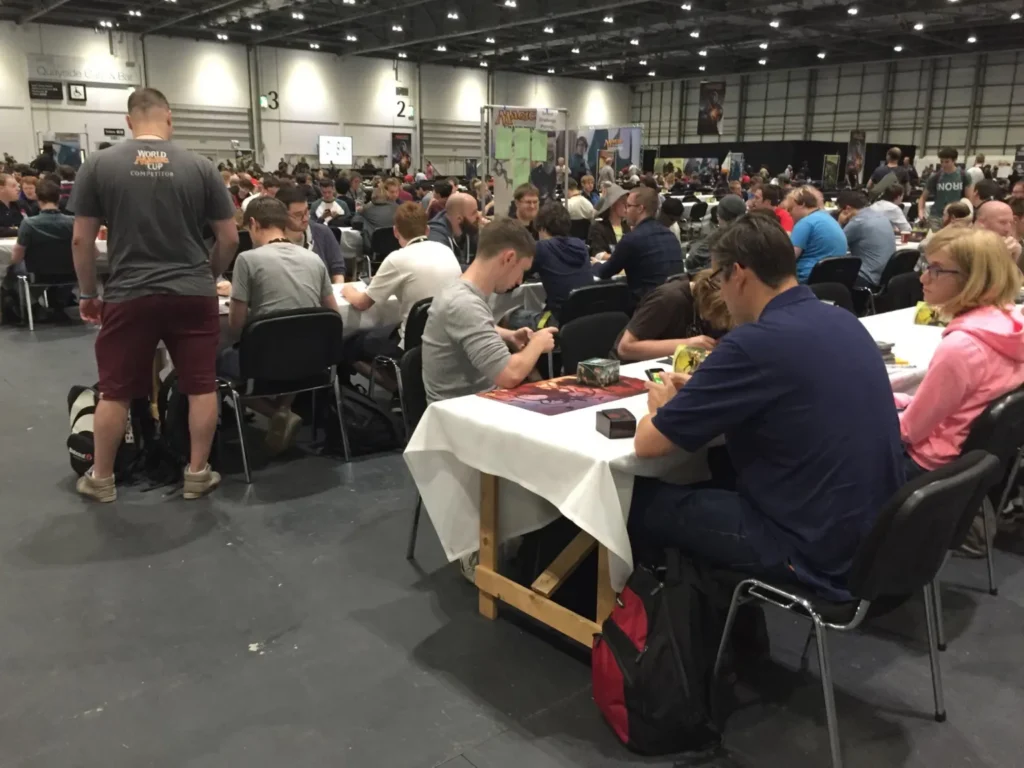
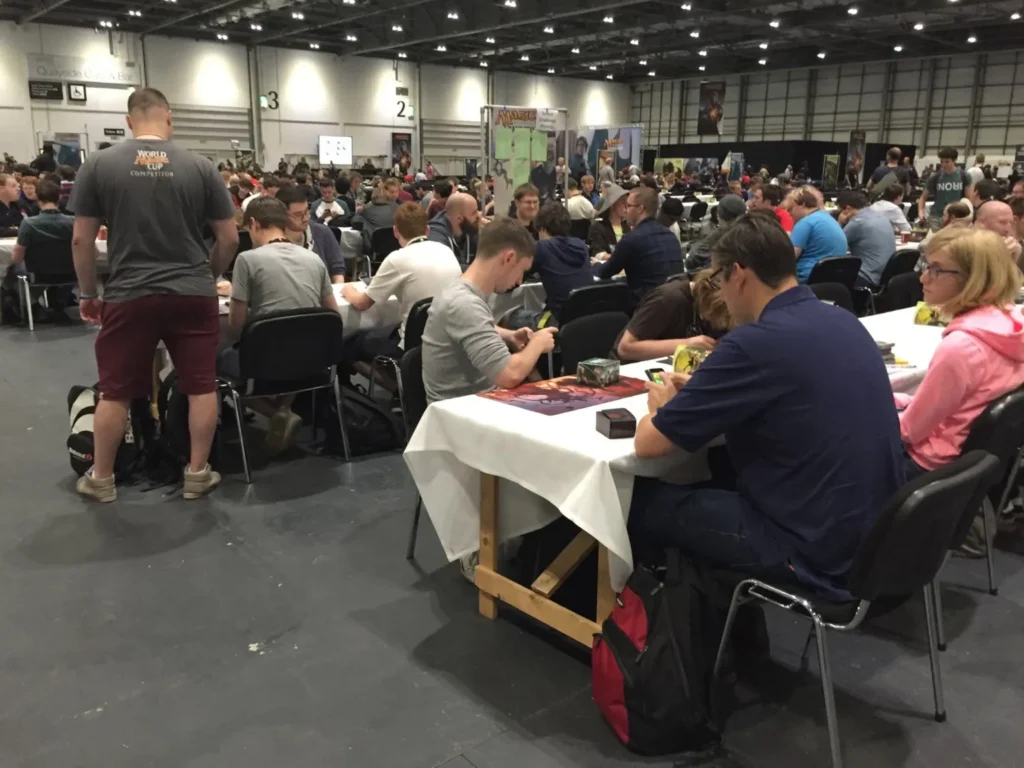
Image is not the property of MatchPunk (source).
We here at MatchPunk believe in the local game store. It’s a good place for supplies, mtg events, and to build community. In fact, we wrote a whole blog post about how the local game store is the best place for beginners to learn Magic 1v1 or Commander (read it here).
But the premise of that post depends on one very important thing: the behavior of the players.
There is a lot you can reasonably expect when you attend an MTG event. Lots of tables. Staff and judges will be there to help you get anything you need. Some people are eager to help you learn. Others are eager to put your deck-building skills to the test.
But the “wild card” in mtg events is whether or not the community of a particular local game store “has good manners”. And, yeah, that might sound aristocratic and posh… but it’s true.
Just like anything in life, the hobby is a lot less fun when people are rude. Another name for “good manners” is etiquette: the unwritten – but still agreed upon – social rules that govern behavior within a group.
This post outlines the proper mtg events etiquette. Lists of suggestions for all of Magic, and then some specific to Standard 1v1 and Commander.
Practices any player can take to make sure they (and everyone else) have a good time. It answers the questions: “How can I be considerate of everyone else?” and “How do I avoid annoying everyone else in the LGS?”.
“How Does Match Punk Make MTG Events Easier?”
Scorekeeper next to you, not in the middle of the table
Keeps everyone’s score… not just yours
Tracks wins/losses… and ranks them based on player skill
Allows for dcustom groups for each individual event
Removes the majority of pre-event organization
Shows a continually updating leaderboard on your phone.
Instantly determines the winner after the event ends.

Image is not the property of MatchPunk (source).
General Player Manners for MTG Events
Say “Hi”: Magic is a game among people. You are playing WITH them, not USING them to have fun. So if they are your friend, take a moment to catch up. If they are a stranger, introduce yourself. Learn a little about them, how long they have been playing, and how they like the event so far. And if you are both using MatchPunk, ask them the story behind their personalized card.
Shuffle your Deck: The game is only fair if both players’ decks are randomized. Which means, if you intentionally do not shuffle, you are basically cheating. So give it 7 solid shuffles to truly randomize the whole deck. And if you want to be a bit theatrical or professional, present your deck to your opponent for a final cut or shuffle. Also, if you just added a bunch of card protectors, be sure to practice shuffling with the protectors. It can feel… different.
Don’t Cheat: On that note… don’t cheat. Ruins the fun. Pretty basic stuff. Not sure I should have to argue this one. If you really need to know why cheating is bad, learn about how “cheating is anti-play” from John Huizinga.
Avoid Slow Play: Free time is a precious resource. We want to spend it playing, not waiting impatiently for someone else to FINALLY take their turn. So strategize, but don’t spend 5 minutes breaking your brain over the perfect move. And if you need to search for a land, do it during the other players’ turn.
Respect Your Opponent: The player on the other side of the table is not your enemy. They are your fellow player. So don’t demonize them when they play well or beat you. Just treat them like a person. Now, this doesn’t mean you need to be stoic. If you have the perfect counter, it’s ok to celebrate. But don’t belittle or go overboard.
Play the Actual Game: When everyone is shuffling, you can talk all you want. But once the game starts, keep the convo to a minimum. Why? Because while it is legal, it’s not great manners to “play a game outside of the game”. Don’t try to distract them with weird conversation or anti-social antics. Reverse psychology through your cards is great! Mind games during their turn is off-putting. Keep respectfully quiet during their turn. This is especially true at mtg tournaments where turns are timed.
Appropriate Trash Talk: Some people love to trash-talk. And among close friends, it can be funny, innocent, even endearing. But many others find it extremely disrespectful and an unnecessary distraction. In this case, what is or isn’t appropriate is determined by how it is received by the other players. Monitor their reactions and adjust your “dissing” accordingly.
Be a Good Sport: How you handle victory and defeat says a lot about you as a player. Winning graciously is just as important as losing gracefully. When you win, be humble. Avoid rubbing it in or dissecting your “skillful” plays in a way that makes your opponent feel bad. Don’t shame the loser. Say “GG” and enter the winner/loser on the MatchPunk app.
“Should I say ‘good game’ after I win a game of Magic?”
This is a surprising but polarizing debate within the Magic community. On the one hand, there is no harm in thanking someone for playing with you. On the other hand, if it WASN’T a good game… if you got lucky or they played terrible… then saying “good game” can feel like rubbing salt in the wound.
A good rule of thumb is this:
- If you are the loser, ALWAYS be the first to extend your hand for a shake and say “good game”.
- If you are the winner, WAIT to see how they respond. If they seem positive, say “good game”. If not, simply wish them luck for the rest of the mtg event.
- Regardless, be genuine, not sarcastic. The goal is to show respect for the time and effort both of you put into the match.
“Why does sportsmanship matter?”
Because sportsmanship keeps the game in a proper context. We are not at war… we are playing a game. It is fun, not life or death. In our opinion, good sportsmanship allows us to enter a competitive environment and honor the hard work of the other side.
“What types of MTG events are available for new players?”
You can find a regularly occurring “Friday Night Magic” at nearly every local game store across the world. But if you are near a city, then Magic nights and Commander nights will be held almost every night of the week. Any of these events is more like a low-stakes meetup, and perfect for beginners.
“What should I bring to be a ‘good Magic player’ at my first event?”
- Your main deck (deck box and sleeves optional)
- A playmat
- Dice for life counters, tokens, etc.
- Pen and paper, life tracker dice, or an mtg life counter app (download Match Punk for free).
Great Reddit quote on bringing your own stuff: “It is very, very annoying when you’re concentrating and the guy beside you is bumming for pen, dice or whatever. Don’t be that guy. Have your own supplies”
Image is not the property of MatchPunk (source).
Manners Specifically for Standard Magic Events
NO TOUCHY!!!!: For the love of all that is good and holy… do not just reach across the table and start fiddling around with your opponent’s cards or deck. A player’s cards are important to them. Aesthetically. Monetarily. Sentimentally. And it feels uber-duper weird for a stranger to manhandle them. Even if it’s way easier for you to flip their card near you, ask before touching your opponent’s stuff (If there is one takeaway you must learn from this blog post, it’s THIS one!).
This Applies to the Graveyard too: On that same note, ask your opponent to see what is in their graveyard. Yes, it is within your rights to know… they have to tell you. But it’s kind and polite to still ask with a please and thank you. Wait for them to turn the card toward you or hold it in front of you. If they hand you their card, handle it with care, and then quickly hand it back.
Inform Your Opponent: You can only strategize if you know what you are playing against. And no one has all 20,000+ magic cards memorized. Make sure the opponent knows what your cards do. Read it out loud. Clearly. And let them take a look at it if they are unfamiliar or confused.
Admire the Cards Later: Cards are cool, we all know that. But you know what is also cool? PLAYING the cards. Doesn’t matter if you are gazing upon some pre-release for the first time. Play the game, and then … when it’s all over… admire the cards. If you simply cannot wait, then at least restrain yourself until your turn is over.
Don’t Eat at the Table: We specifically reserve this suggestion for official (or at least more serious) Magic: The Gathering events. Because odds are, the average weekly magic night is going to have snacks and drinks galore. But if you are at a meaningful, competitive tournament, then wait to eat and drink until after the match is over. It’s just way too easy for spills to ruin a really expensive deck. If you have to stay hydrated, keep it in a spill-proof water bottle.
Don’t Interfere with Other Games: If your game ends before other matches… or you are taking a break… you might pass the time watching others play. Great! But you know what’s not so great? Commenting (or criticizing) the players in any way. Even encouragement can be a distraction. But don’t talk directly to them until their match has ended.
Consult the Judge: During MTG events, there will be judges nearby to adjudicate various cards and rules. They are the authority. Not you. Not your opponent. Not bystanders. Not ChatGPT. Lean on the judges to provide the correct ruling. This is especially true if you are a young player… do not let some arrogant vet boss you around.
No Take Backs: Its the timeless Chess rule; so long as your hand remains on the piece (in this case… card), you can continue your move. But in Magic, as soon as you have finished your turn, you are done. You can’t go back and untap your mana. Some Commander pods might let you do something obvious, but Magic is much more competitive… you should play as though all of your decisions are final.
“What is expected tournament etiquette at Magic: The Gathering events?”
Be friendly and respectful before, during, and after the game. Keep everything above board; make sure your opponent knows your move and what your cards do. Don’t be a bad sport and don’t eat food at the table. Shuffle your deck, play at a reasonable pace, and follow the rules… asking a judge to make a ruling if necessary.

Image is not the property of MatchPunk (source).
What Makes a Good Commander Player?
Commander is a unique format. It’s often described as being governed by a “social contract” more than a rigid set of rules. Its goal is simple: hang out and have fun. And because of this, there are some good gamer manners specific to Commander:
Allow Pre-Game Conversation: Commander is a social game. You aren’t just expected to play… you are expected to play with friends or make new ones. Engaging in pre-game conversation fosters a sense of community and connection among players.
Welcome New Players: And as helpful as blog posts like this one can be for beginners… it’s by engaging with other players that the game grows. And that starts with welcoming everyone. Don’t roll your eyes when they are trying to figure out a move… be patient. Don’t mock them for not knowing jargon… be helpful. And don’t roll your eyes when they ask for rules clarification… be helpful.
Match the Pod’s Tone: Commander is less one-dimensional than standard. There is one set of rules but a lot of ways to play. Which is why every pod has a different vibe. Some are experimenting with decks or strategies. Others are open to a ruthless 3-hour slog. Match the energy of the group you’re with. Don’t throughout your high-power deck and pub stomp a bunch of people just having a good time.
Let Cooler Heads Prevail: Understand that in Commander, it often occurs that players will gang up on someone who is in a weak position. DO NOT TAKE THIS PERSONALLY. Just relax and at least take solace knowing that some players consider you enough of a threat to want to eliminate early. If you play your cards right, the tides will shift back in your favor.
Discuss Decks BEFORE Playing: To elaborate on the point above, different decks result in different games. An overwhelming stax deck might give you the win, but will guarantee the player planning a lot of landfall will have zero fun. So before playing, discuss the deck you are planning on using, and make sure no deck negates an opponent’s too much. A friendly conversation about mana curves and sideboard inclusions can enhance mutual respect while keeping the game enjoyable for all participants.
“How can I avoid being seen as a difficult player in Commander?”
Don’t take it too seriously. Don’t ignore the social dimension. Don’t play a deck that will keep others from playing and having fun. Don’t play the whole game defensively. Keep the game moving; pick a play that makes sense and go for it.

Image is not the property of MatchPunk (source).
Conclusion: Hygiene MATTERS
No…this isn’t just a snide joke. “Con funk”, “store stench”, whatever you want to call it, is a VERY real thing. It could be a very NON-real thing if everyone would just bathe, deodorize, wear clean clothes. Being mindful of your personal grooming is a simple act of courtesy. Staying clean. Smelling good. In public. It matters.
Shower within 24 Hours: This isn’t a royal ball; you don’t have to get all dolled up to sit on a plastic table and throw down some cards. But this also isn’t a gym or worksite. You’re in public with fellow humans with noses. You have to bathe.
Mind the Bad Breath: You’ll be playing across the table from a fellow human being. Good chance they might catch a whiff of your heavy breathing after they play a board wipe card. Brush your teeth. Pop a tic-tac. Choose “Mentos: the Freshmaker”. Or at least have them on hand after you finish your extra-loaded chorizo nachos.
If Necessary, Wear Deodorant: Some people shower and are pretty much set for a whole day. Others have some body odor and need a little extra help after hopping out of the shower. If that’s you, there is zero shame in wearing some deodorant or body spray. If you need it, then it is as essential for MTG events as your deck or Commander card (NOTE: this does not replace the need for a shower).
Wear Appropriate Attire: “Appropriate” for a local game store is going to be different than for school or a funeral. Your Iron Maiden t-shirt is perfect. But don’t wear something weirdly violent, obscene, sexual, or revealing. Remember, there are going to be some kids there having fun. Which means that a fishnet mesh shirt with fluorescent tape over the nipples would be an excellent example of “inappropriate”.
About the Author: This post was written by tabletop games marketing and writing agency Riley James Copy.
If you want to create and sell your own magic or tabletop game product, then click the link and learn about how he can help with board game marketing.
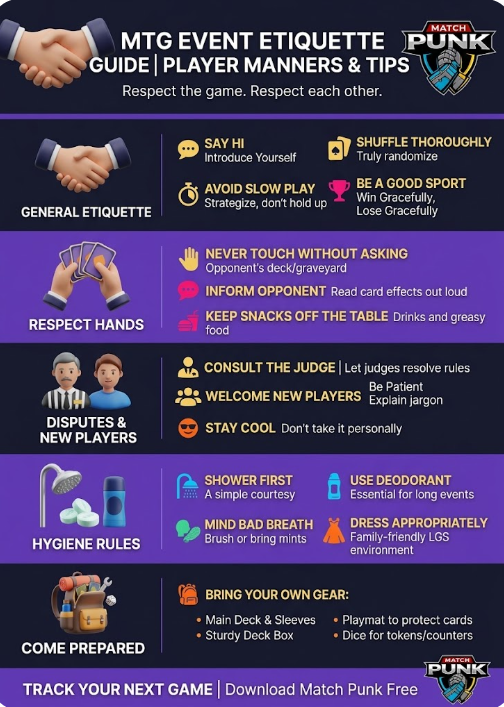
Learn more about MTG Event Etiquette Guide | Player Manners & Tips
1. What Are MTG Events? A Quick Tour for Beginners
If you’re new to Magic, “MTG events” can mean anything from a four-person Commander night to a Pro Tour qualifier. They aren’t all the same. The etiquette expectations shift with the tier. Here’s the short version of what you’ll actually encounter at your LGS or beyond.
Friday Night Magic (FNM): Weekly sanctioned event at WPN (Wizards Play Network) stores. Casual, beginner-friendly, often with promo cards as prizes. Most players’ first sanctioned tournament.
Prerelease: Held the weekend before a new set launches. Sealed format: you build a 40-card deck from six booster packs you open at the event. Famously welcoming to new players and the best on-ramp into sanctioned play.
Commander Night: Casual multiplayer pods, typically four players at a table, often run weekly at LGSs. No formal pairings and no required judge presence. The social contract matters more than the rulebook here.
Store Championship / Regional Championship Qualifier (RCQ): Higher-stakes competitive events. Stricter enforcement, different time pressure, and different etiquette expectations than your local FNM.
Magic Spotlight Series / Pro Tour qualifying events: Premier-level competitive play. If you’ve made it here, this guide isn’t your introduction, but the manners still matter.
The full official events calendar and store locator live at magic.wizards.com.
2. MTG Event Tips for New Players: Before, During, and After Your First Event
The single most useful etiquette framework for a beginner isn’t a list of rules. It’s a timeline. In our experience watching first-timers at FNMs and prereleases, most awkward moments come from showing up unprepared, drifting through the round without communicating, or bouncing the second the loss column ticks up. Here’s the simple version, broken into the three phases that actually matter.
Before the Event
- Verify the format and start time on the store’s social media or WPN listing the day before. Showing up to a Modern night with a Pioneer deck is a story you only want to tell once.
- Build or proxy-test your deck the night before. Not in the parking lot.
- Bring your supplies: deck, sleeves, playmat, dice or a free MTG life counter app (we recommend Match Punk), a pen, and a deck box.
- If it’s a Constructed event, write out a decklist legibly. Many stores still accept paper lists at the door.
- Eat first. Bathe. Brush. The hygiene section above isn’t a joke. It matters.
During the Event
- Introduce yourself before the round starts. “Hey, I’m [name], first FNM for me, appreciate your patience” works perfectly. Almost every player responds with warmth.
- Shuffle your deck thoroughly and present it for a cut.
- Announce phases clearly: “Going to combat.” “End of turn?” Verbal priority prevents most disputes before they happen.
- Ask before touching anything on your opponent’s side of the table: cards, dice, playmat, deck box.
- Call a judge for any rules question. Both players, no penalty, neutral outcome. Judges exist to help, not to penalize.
- Track life totals and damage consistently across the whole match. Match Punk handles life, commander damage, and every counter type for every format, free.
After the Event
- Sign the match slip honestly. Report your result promptly to the pairing app or to the table.
- Say “good game,” mean it, and stick around for the next round even if you lose.
- If you traded between rounds, double-check what you walked away with before leaving the table.
- Thank the store and the judge on your way out. LGS staff remember new players who say thanks.
▸ Ready to ditch the dice? Match Punk runs life totals and counters for every format. Free, no account required to start. Try Match Punk →
3. MTG Etiquette for Beginners: The 10 Things to Get Right First
If you remember nothing else from this guide, remember these ten. After hundreds of Commander pods and FNM rounds, we’ve found these are the rules whose violation causes about 95% of the friction we see at tables.
- Shuffle your deck before every game. Even if you just shuffled. When your opponent presents, you cut or shuffle again. This isn’t paranoia; it’s the rule.
- Ask before touching your opponent’s cards, dice, or playmat. Always. Their stuff, their boundary, no exceptions.
- Announce your phases out loud. “Untap, upkeep, draw.” “Main phase one.” “Going to combat.” Verbal priority is how disputes get prevented before they start.
- Read your cards aloud the first time you cast them. Your opponent has not memorized 30,000 cards. Make sure they know what’s happening on the stack.
- Call a judge for any rules dispute. Both players, no penalty, neutral outcome. That’s literally what judges are for.
- Play at a reasonable pace. Don’t tank simple decisions for several minutes. Slow play is an actual tournament infraction. More on that below.
- Track life totals accurately. Don’t fudge in your favor. Ever. If you lose track, ask your opponent or check the app.
- Concede gracefully. Win humbly. Both matter equally. A sarcastic “gg” lands worse than no “gg” at all.
- Keep food and drinks off the play surface. A spilled energy drink can ruin a $200 sleeve job in three seconds.
- Show up clean and bring your own supplies. You don’t need to dress up. You do need to shower and have your own deck box, sleeves, dice or counter app, and a pen.
4. MTG Tournament Etiquette: The Rules Behind the Manners
Tournament etiquette isn’t just good manners. Most of it is codified in the Magic Tournament Rules (MTR) and the Infraction Procedure Guide (IPG). The expectations scale with the Rules Enforcement Level (REL) of the event you’re playing in. Knowing which tier you’re at is the first step to behaving correctly.
What Is REL?
REL stands for Rules Enforcement Level. It’s the framework Wizards uses to set the rules-strictness and judge-presence of a sanctioned event. There are three tiers, and your behavior should adjust to match the tier you’re playing in.
| REL | Where You’ll See It | Etiquette Expectations |
|---|---|---|
| Regular | FNM, Prereleases, Commander nights, draft leagues | Friendly enforcement. Judges teach more than they penalize. Minor mistakes are corrected with grace. Take-backs are usually not allowed, but the bar for warnings is high. |
| Competitive | Store Championships, RCQs, large open events | Strict enforcement. Decklist accuracy, slow play, and communication policy all matter. Penalties can escalate to game losses. |
| Professional | Pro Tour, Magic Spotlight Series, World Championship | Strictest enforcement. Multiple judges per area. Top-of-line precision expected from every player at every turn. |
Slow Play (MTR 5.5)
Slow play is a tournament infraction defined in MTR 5.5. It covers players who take unreasonable time to make decisions, including stalling on simple plays. At Regular REL, slow play earns you a friendly nudge from the judge. At Competitive REL, the same behavior can result in a formal warning and, with escalation, a game loss. Both you and your opponent can call a judge for slow play at any time.
Decklist Accuracy
At Competitive REL and above, your decklist must match your deck exactly. A mismatched decklist, even by one card, can mean a game loss or a deck check penalty. At Regular REL, the rules are looser, but writing your list legibly and turning it in on time still matters. We’ve watched first-time tournament players take an avoidable game loss for writing 59 cards on a 60-card list.
Sideboarding Window
Between games of a best-of-three match, you get three minutes to sideboard. That’s it. Players who burn six minutes deciding which two cards to swap are committing slow play before game two has even started.
End-of-Round Procedure
Standard tournament rounds run 50 minutes. When time is called, the active player finishes their current turn, and then the match plays five additional turns (turn 0 plus turns 1 through 4 of extra play). If neither player has won at the end of turn 5, the match is a draw. Knowing this changes how you play late in a round, and how willing you should be to take risks when you’re behind.
Communication Policy
At Competitive REL, game information falls into three categories:
- Free information: Must be shared accurately when asked: life totals, the number of cards in hand, mana pool contents.
- Derived information: Calculable from public information: what’s in a graveyard, what’s on the battlefield. You don’t have to volunteer it, but you can’t lie if asked.
- Status information: Game-state checks: what your tapped lands represent, what your face-down morphs are once revealed. You have to be accurate.
Bluffing about derived information is allowed. Lying about free information is cheating.
Why “Take-Backs” Don’t Exist in Sanctioned Play
Once you’ve committed a play (moved a card from hand to battlefield, declared an attacker, paid a cost), the play is final. Even at Regular REL, judges are reluctant to roll back game actions because of the precedent it sets. The Commander pod at your kitchen table might let you untap that land you accidentally tapped. The FNM judge won’t.
The full Magic Tournament Rules and Infraction Procedure Guide are published by Wizards at magic.wizards.com. Both are worth a skim before your first Competitive REL event.
5. Commander Etiquette: Rule 0, Brackets, and the Social Contract
Commander is the most popular MTG format, and it’s the format where etiquette matters most, because the rules give you a lot of room to ruin the night for three other people. The format runs on a “social contract” reinforced by two specific tools every Commander player should know: the Rule 0 conversation and the Commander Bracket System.
The Rule 0 Conversation: How to Have It Without Being Weird
Rule 0 is the 30-second pregame conversation where pod members align on deck speed, win conditions, infinite combos, mass land destruction, stax pieces, and proxies. It’s called “Rule 0” because it happens before any official rule of Commander applies. After running our own Commander nights for years, we’ve found that skipping the Rule 0 conversation is the single most common cause of bad games.
A sample Rule 0 script that works at almost any LGS:
“I’m running a Bracket 3 [Commander]. Aiming to win around turn 8–10. No infinite combos, no mass land destruction. Two proxies, both clearly marked. Cool with everyone?”
That’s it. Thirty seconds. Everyone now knows what they’re playing into, and the pod can adjust deck choice or expectations before a single card is drawn.
The Commander Bracket System: What the Numbers Actually Mean
In 2024–2025, Wizards introduced the official Commander Bracket System, a 1-to-5 framework for matching Commander deck power levels across casual and competitive play. The brackets are:
- Bracket 1, Exhibition. Themed decks, intentional jank, “five-color frogs” energy. Pure casual fun.
- Bracket 2, Core. Precon-level. Newer players, lightly modified preconstructed decks.
- Bracket 3, Upgraded. Tuned-up precons, casual pods with strategy and a game plan.
- Bracket 4, Optimized. High-power, non-cEDH. Tuned, fast, focused decks built to win.
- Bracket 5, cEDH (competitive EDH). The top end. Tournament-tuned Commander with optimized mana, fast combos, and full interaction suites.
The point of brackets isn’t to gatekeep. It’s to give your Rule 0 conversation a shared vocabulary. “Bracket 3” communicates more in one number than “kind of casual but not too casual” does in a paragraph. Wizards’ official framework lives at magic.wizards.com.
Pubstomping, Salt Mining, and the Other Things That Get You Uninvited
A few specific Commander etiquette violations come up often enough to have their own names. Watch out for them in your own play, and don’t panic when you spot them in someone else’s.
- Pubstomping: Bringing a tuned, high-power deck to a casual pod running precons or upgraded decks. The most common Commander etiquette violation, and almost always unintentional, which is exactly why Rule 0 matters.
- Salt mining: Playing strategies designed to frustrate rather than win: stax pieces in a casual pod, locking everyone out without a clear win condition.
- Kingmaking: When you can’t win, throwing the game to spite one specific opponent rather than playing it out neutrally.
- Scoop trolling: Conceding in response to a beneficial trigger or to deny someone a finisher. Technically legal; socially radioactive.
▸ Match Punk tracks commander damage from every source independently (including partners and backgrounds), so your pod never argues about the count. Try Match Punk →
6. MTG Etiquette by Format: A Quick Comparison
Different formats run on different social contracts. The shuffle still matters everywhere, but the pace, communication norms, and weight of the social contract shift noticeably between Standard and Commander. Here’s the quick reference.
| Format | Starting Life | Pace | Social Weight |
|---|---|---|---|
| Standard / 1v1 Constructed | 20 | Quick. 50-minute rounds. | Low. Strangers, competitive, focused on the match. |
| Commander / EDH | 40 | Slow. 1–3 hour games are normal. | High. Rule 0 essential, four-player diplomacy. |
| Draft / Sealed | 20 | Medium. 50-minute rounds. | Medium. Shared opening of packs sets a friendlier tone. |
| Two-Headed Giant | 30 (shared) | Slow. Team coordination needed. | Medium-high. Partner communication matters as much as opponent etiquette. |
| Pauper | 20 | Quick. 50-minute rounds. | Low. Same as Standard, with a budget-friendly community vibe. |
7. What NOT to Do at an MTG Event (Quick Reference)
A few things never play at an MTG event regardless of format or REL. Memorize this short list. It covers the violations that most often get a player flagged with judges, store owners, or playgroup chats.
| Don’t | Why |
|---|---|
| Tank obvious decisions for several minutes. | It’s slow play. Judges can issue warnings, and at Competitive REL, those escalate to game losses. |
| Argue rulings with your opponent. | Call a judge. Both players, neutral outcome, zero penalty for asking. |
| Comment on or react to adjacent games. | Even encouragement counts as interference. |
| Take back a play once you’ve committed it. | The card is placed; the play is final. No exceptions in sanctioned play. |
| Sleeve a tuned cEDH deck for a casual pod. | That’s the textbook definition of pubstomping. |
| Critique your opponent’s deck mid-match. | Save it for after, and only if they ask. |
| “Forget” your own triggers when they hurt you. | Missed triggers don’t trigger, but doing it intentionally is cheating. |
| Touch your opponent’s cards, dice, or playmat. | Their stuff, their boundary. Always ask first. |
| Eat over the play surface. | One spill can ruin hundreds of dollars of sleeves. |
8. Frequently Asked Questions About MTG Events Etiquette
These are the questions we get most often from players new to Friday Night Magic, Commander pods, and tournament play. Answers reflect how Magic is actually played at our local LGSs, not idealized scenarios.
What is MTG etiquette?
MTG etiquette is the set of behaviors players expect of each other at sanctioned and casual Magic: The Gathering events. It covers three core categories: general player manners (shuffling, announcing phases, asking before touching), tournament rules (slow play, decklist accuracy, communication policy), and the Commander social contract (Rule 0, bracket alignment, no pubstomping). See the sections above for the full guide.
What should I bring to my first MTG event?
Bring your deck, sleeves, a playmat, dice or a free life counter app (we recommend Match Punk), a pen, and a deck box. For Constructed events, also bring a written decklist. Most stores provide tokens and rule reference materials, but bringing your own backups never hurts.
What is Rule 0 in Commander?
Rule 0 is the 30-second pregame conversation Commander players have to align on deck power, win conditions, combos, stax, mass land destruction, and proxies before the game begins. Most pod conflicts come from skipping it. The Commander Bracket System is the shared vocabulary that makes the Rule 0 conversation fast and clear.
What is the Commander Bracket System?
The Commander Bracket System is Wizards of the Coast’s official 1-to-5 framework for matching Commander deck power levels. Bracket 1 is Exhibition (themed or jank). Bracket 2 is Core (precon-level). Bracket 3 is Upgraded. Bracket 4 is Optimized. Bracket 5 is cEDH. It’s the standard vocabulary every Commander player should learn.
What is slow play in MTG?
Slow play is a tournament infraction defined in Magic Tournament Rules section 5.5. It covers players who take unreasonable time to make decisions, including stalling on simple plays. At Regular REL (like FNM), judges typically warn. At Competitive REL, slow play can escalate to a game loss.
How do I behave at my first FNM?
Introduce yourself before the round, shuffle thoroughly and present your deck, ask before touching anything on your opponent’s side of the table, call a judge for any rules question, play at a reasonable pace, sign your match slip honestly, and thank the store on the way out. Most players are happy to help a beginner.
Should I say “good game” after winning?
Yes, but only if you mean it. A genuine “gg” closes the match well. A sarcastic one rubs salt in the wound. A good rule of thumb: if you’re the loser, extend the handshake first. If you’re the winner, wait for them to set the tone, then match it. The goal is genuine respect for the time both of you put in.
Can I take back a move in Magic?
No, not in sanctioned play. Once you commit a play (move a card, declare an attacker, pay a cost), it’s final. Some casual Commander pods allow take-backs by group agreement, especially for obvious misclicks. Don’t expect that flexibility at FNM or any Competitive REL event.
What is REL in MTG?
REL stands for Rules Enforcement Level. There are three tiers: Regular (FNM, prereleases, Commander nights), Competitive (Store Championships, RCQs, large opens), and Professional (Pro Tour, Magic Spotlight Series). Etiquette expectations and penalty severity both scale up with REL.
How long does an MTG tournament round last?
A best-of-three match at Regular or Competitive REL runs 50 minutes. When time is called, the active player finishes their current turn, and then the match plays five additional turns. If no one has won at the end of those turns, the match is a draw.
What is pubstomping in Commander?
Pubstomping is bringing a tuned, high-power Commander deck to a casual pod running precons or lower-bracket decks. It’s considered the most common Commander etiquette violation. It’s almost always unintentional, which is exactly why the Rule 0 conversation and the Bracket System exist.
Why does sportsmanship matter in MTG?
Sportsmanship is what keeps MTG events welcoming to new players and worth attending for veterans. Magic is a community of people who play repeatedly with each other across years. Honest play, gracious wins, and respectful losses are what keep that community functioning, and what gets players invited back to the table.
9. TL;DR: The MTG Etiquette Summary
MTG events etiquette is the set of behaviors players expect of each other across general play, sanctioned tournaments, and the Commander social contract. The fundamentals are simple even when the details aren’t. Show up prepared and play honestly. The rest is in the bullets below.
- Shuffle thoroughly, present for a cut, and announce your phases out loud.
- Bring your own supplies: deck, sleeves, playmat, dice or a free life counter app like Match Punk.
- Call a judge for any rules dispute. That’s what they’re there for, and there’s no penalty for asking.
- Play at a reasonable pace. Slow play is a real infraction at any REL, and a real annoyance at every kitchen table.
- Have the Rule 0 conversation before every Commander game. Brackets are your shortcut.
10. Track Your Next MTG Event with Match Punk
Good etiquette gets you through the door. A good scorekeeper gets you through the night. Match Punk is the free Magic: The Gathering life counter and match scorekeeping app built for every event, every format, and every pod size. Life totals, commander damage from every source, counters for poison, energy, experience, and custom values, plus full match history saved automatically.
Free. Fast. Built for players. No ads, no paywalls, no account required to start.
▸ Track your next FNM or Commander pod with Match Punk. Try Match Punk →
11. Related Reading from the Match Punk Blog
- Best MTG Digital Life Counter App vs. Physical: when dice, pen-and-paper, and apps each make sense (and when they don’t).
- Match Punk Blog: guides, format breakdowns, and game-night tips for every Magic player.
- How Match Punk Works: a quick walkthrough of life counting, commander damage tracking, and match history.
- Match Punk Features: every feature included free, with no premium tier hiding the good stuff.
We here at MatchPunk believe in the local game store. It’s a good place for supplies, mtg events, and to build community. In fact, we wrote a whole blog post about how the local game store is the best place for beginners to learn Magic 1v1 or Commander (read it here).